Hail season on the plateau
Supercells build over eastern Oklahoma in the spring, ride up the Boston Mountains and unload on Washington and Benton Counties — most years between March and June, with May the peak. The record in a 25-mile circle around Fayetteville runs to 116 tornadoes since 1950, and the 2020s are the busiest decade yet; hail rides along with almost every one of those storms. The recent ones: the May 26, 2024 outbreak that put two EF-3 and two EF-2 tornadoes through Benton County with $80 million in property damage; the April 20, 2025 storm that produced hail and an EF-1 tornado through Hughmount Village on Fayetteville's west side; May 18, 2025, when 1¾-inch hail hit Springdale, 1¼-inch hit Johnson and inch hail hit Tontitown; and the June 18, 2025 EF-1 near West Fork.
What hail does to a shingle
A hailstone hits an asphalt shingle and does three things: knocks the granules loose, crushes the asphalt underneath, and — if it's big enough — fractures the fiberglass mat. The granules are the shingle's sunscreen; without them the asphalt bakes and cracks. The fractured mat is the leak, but not today: it lets water into the shingle, the water freezes and thaws, and the crack opens over a year or two. That's why a roof that "looks fine" after a storm leaks two summers later, and why insurers want the claim documented close to the storm date.
How big is big enough?
- ¾ inch (penny): knocks granules off an old, brittle shingle; rarely a claim on its own.
- 1 inch (quarter): bruises an aging architectural shingle, especially on a north slope that stays soft; the threshold most adjusters start looking at.
- 1½ inch (ping-pong): bruises most standard shingles regardless of age. Dents gutters and vent caps.
- 1¾ inch (golf ball): what Springdale took on May 18, 2025. Cracks mats, splits old shingles.
- 2 inch (egg) and up: breaks shingles outright, cracks skylights and siding. A Class 4 shingle is tested to a 2-inch steel ball.
The test square
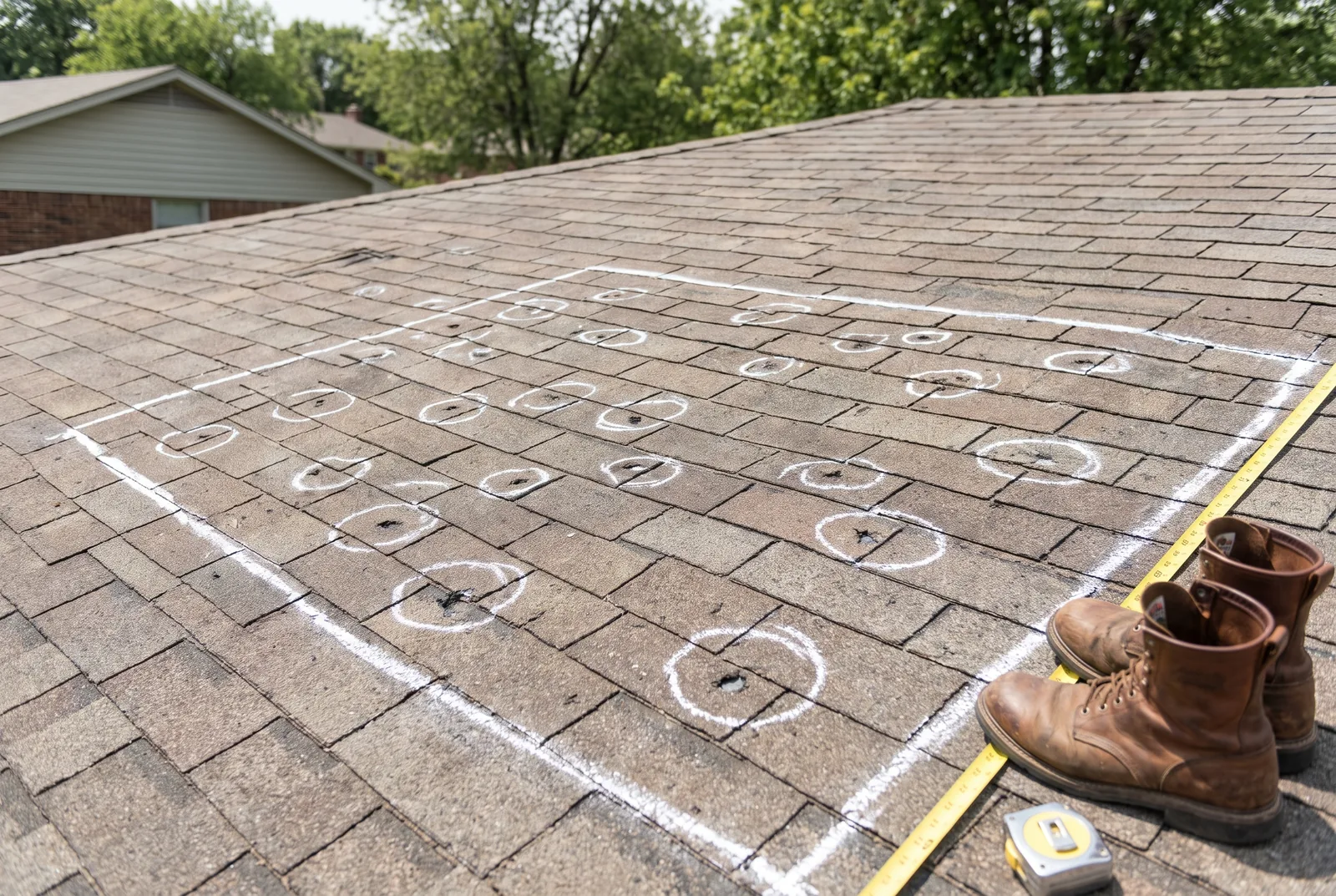
We chalk a 10-by-10-foot square on each slope, circle every hail hit inside it, and photograph it with a date stamp. Most carriers treat eight or more hits in a square as a slope that gets replaced; fewer is a repair. We also check the "soft metals" — gutters, downspouts, vent caps, the AC condenser fins, window screens — because they record hail size honestly and prove the storm reached your house even when the shingles are debatable. Then we pull the radar-confirmed hail size and wind for your address on the storm date and attach it to the estimate.
Claim, repair or nothing?
This is the honest conversation, and it changed after 2023. Arkansas insurers, having lost three in-state companies, rewrote roof coverage: many policies now pay full replacement cost only for roofs under about seven years old and depreciate older ones, roofs past twenty years may get actual cash value only, and a separate wind/hail deductible of 1–2 percent of the dwelling value is common. So before you file, know your roof's age, your policy's roof schedule and your wind/hail deductible. If the damage is a handful of hits and your deductible is $4,000, we'll repair it for a few hundred dollars and leave your policy alone. If every slope is bruised and the roof is five years old, file. Read the insurance guide for the details.
Spotting a storm chaser
They arrive within 48 hours of a hail day. Out-of-state plates, a door-knock, a "free inspection" that's really a sales call, an offer to "handle" or "waive" your deductible, a contract that assigns them your claim, and no Arkansas registration number. Arkansas requires every residential roofer on a job over $2,000 to be registered and bonded for $15,000; ask for the number and call (501) 372-4661. The permits and registration guide has the full checklist.
Common questions
Can I see hail damage from the ground?
Rarely. Look at the gutters, downspouts and vent caps for dents and at the downspout outlets for granules — those tell you hail hit. The shingles need a test square on the roof.
Will a Class 4 shingle stop hail damage?
It resists mat fracture — the leak — up to a 2-inch stone. Very large hail can still leave cosmetic marks, and some policies exclude cosmetic damage on impact-rated roofs. It's still the best shingle for this county.
How long do I have to file after a storm?
Most Arkansas policies allow a year from the date of loss, some two. Sooner is better: damage from a May storm is hard to separate from the next one by fall, and adjusters know it.
Does hail damage a metal roof?
Large hail can dent lighter-gauge panels cosmetically but won't crack them or cause a leak. Many policies exclude cosmetic dents on metal; we'll tell you what yours says.
My neighbor got a new roof from the storm. Will I?
Maybe. Hail falls in streaks — one side of a street can take golf balls and the other pennies — and roof age and policy schedules differ. The free inspection answers it for your roof.
Related: Hail & storm damage · Roof insurance claims · Class 4 shingle roofing · Arkansas roof insurance guide